Congratulations to Dr. Durvudkhan Suragan on being awarded the prestigious
Order of Kurmet
by the President of Kazakhstan! The Order of Kurmet (Order of Honour) is a state award established in 1993, recognizing outstanding contributions in the fields of economics, science, culture, social development, and education.
It is our pleasure to announce the next Ghent Methusalem Microlocal Day # 12, which will take place on Tuesday, 8 April 2025.
The Microlocal Day is an event featuring a brief and intensive series of lectures on various aspects of microlocal analysis and related topics. The program consists of both research presentations and survey lectures intended for researchers and PhD students interested in the field.
11:05-11:50.Sergo Yepiskoposyan (National Polytechnic University of Armenia, Armenia)
Title:Orthonormal Systems and Greedy Algorithms
Abstract: The lecture will present classical orthonormal systems such as Rademacher, Walsh, Haar, Christenson-Levy systems and their properties. As well as greedy algorithms for these systems. Convergence results of the greedy algorithm for the Walsh system in the spaces $L^1[0,1)$ and $L_{\mu}^1[0,1)$ will be presented.
Abstract: We will discuss the wave equations that becomes weakly hyperbolic and singular at time t = 0. We provide precise quantifications for the asymptotics of solutions as t approaches 0, the scattering problem and the loss of regularity caused by the degeneracies at t = 0.
15:40-16:00. Aidyn Kassymov (Institute of Mathematics and Mathematical Modelling, Kazakhstan):
Title: On fractional inequalities on metric measure spaces with polar decomposition
Abstract: In this paper, we prove the fractional Hardy inequality on polarisable metric measure spaces. The integral Hardy inequality for 1<p≤q<∞ is playing a key role in the proof. Moreover, we also prove the fractional Hardy-Sobolev type inequality on metric measure spaces. In addition, logarithmic Hardy-Sobolev and fractional Nash type inequalities on metric measure spaces are presented. In addition, we present applications on homogeneous groups and on the Heisenberg group. (joint paper with M. Ruzhansky and G. Zaur).
16:00 – Closing.
This Microlocal Day continues the tradition of Microlocal Days that we have been organising at Imperial College London, then continued at Ghent University. So, this Microlocal Day can be viewed as Microlocal Day #12.
Topic: A brief introduction to modulation spaces on the Heisenberg group Time: Thursday, 3rd April, 2 PM – 4 PM CEST
Friday, 4th April, 10 AM – 12 PM CEST Where:Leslokaal 3.1 (Krijgslaan 281, Building S8, Ghent University)
The lecture begins with a review of the definition of modulation spaces on R^n, reformulated using the Bargmann transform. It then introduces twisted modulation spaces through the twisted Bargmann transform. Finally, modulation spaces on the Heisenberg group are presented as direct integrals of twisted modulation spaces. The lecture concludes with a discussion of some fundamental properties of these spaces.
Miquel Saucedo CRM, Universitat Autonoma de Barcelona, Spain
Topic: Every classical inequality for the Fourier operator is trivial Time: Thursday, April 3rd, 11:00 AM-12:30 PM CEST Where:Leslokaal 3.2 (Krijgslaan 281, Building S8, Ghent University)
In this talk, we will see that if the Fourier operator is bounded between two classical spaces (for instance, rearrangement invariant spaces), then every operator that maps L1 and L2 to Linfty and L2, respectively, must also be bounded. We will also discuss why this means that there cannot be any “interesting” classical Fourier inequalities and give some applications. This is joint work with Sergey Tikhonov.
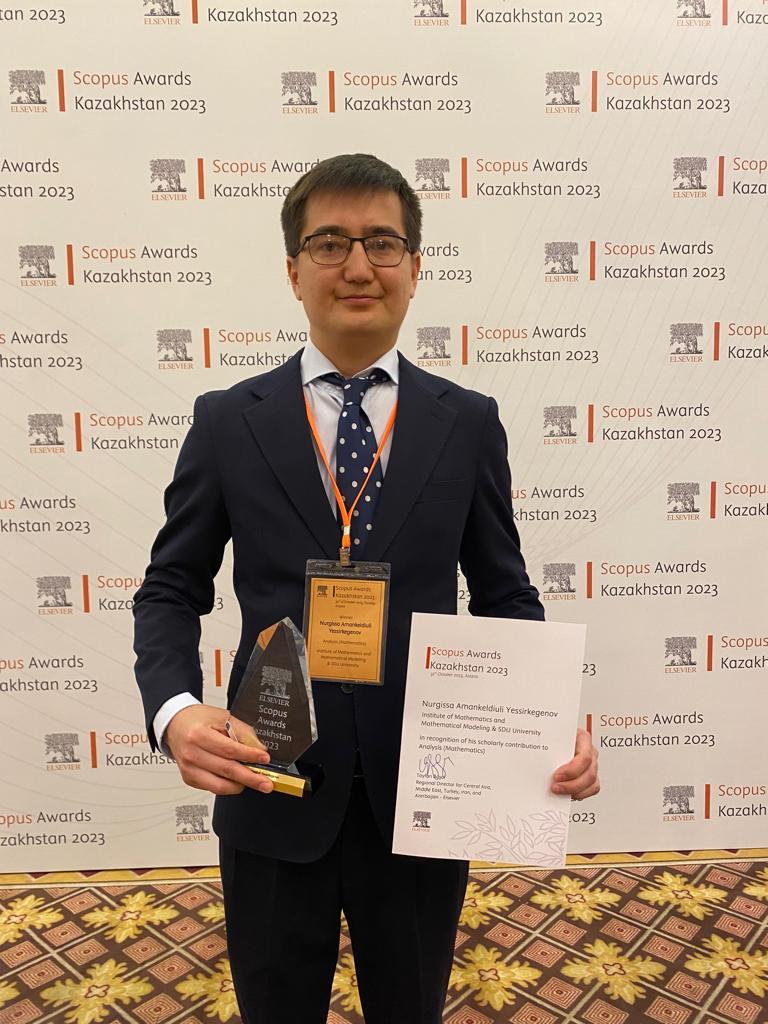
Congratulations to Aidyn Kassymov and Nurgissa Yessirkegenov for receiving the nomination of
The Best Researcher Kazakhstan 2024
Their exceptional research contributions have greatly advanced our understanding of various fields, making them a deserving candidate for the Best Researcher nomination in Kazakhstan for 2024. We are proud to recognize their unwavering commitment to innovation and excellence, which inspires peers and students alike. This nomination not only highlights their remarkable achievements but also underscores their significant impact on the research community in Kazakhstan.
ACOMEN2025 provides a global platform for presenting and discussing cutting-edge advancements in computational and applied mathematics across diverse engineering and scientific disciplines.
📝 Program Topics Include:
Applied and Computational Mathematics
Computational Solid and Fluid Mechanics
Computational Material Science & Electromagnetism
Biomechanics and Computational Natural Sciences
Data-Driven Methods and AI in Modeling
Fluid-Structure Interactions and Coupled Problems
High-Performance Scientific Computing
Inverse Problems & Machine Learning
New Discretization Methods & Numerical Analysis
Optimization Methods
Partial Differential Equations
Numerical analysis
Scientific Computation Software
Simulation of Manufacturing Processes
Uncertainty Quantification and Stochastic Modeling
🎓 Plenary Speakers:
We are honored to host renowned experts in the field:
Peter Bastian (Universität Heidelberg)
Paul Bressloff (Imperial College London)
Jerome Droniou (University of Montpellier)
Jan S. Hesthaven (École Polytechnique Fédérale de Lausanne)
Barbara Kaltenbacher (Alpen-Adria-Universität Klagenfurt)
Michael Klibanov (University of North Carolina at Charlotte)
Matti Lassas (University of Helsinki)
Barbara Wohlmuth (Technical University of Munich)
📝 Call for Abstracts and Mini-Symposium Proposals
Abstract Submission:
Submissions are now open! Templates and submission forms are available on our website.
Mini-Symposium Proposals:
Propose a mini-symposium with:
A tentative title
A brief description
Contact details for at least four speakers
Send your proposal to acomen2025@ugent.be, and we’ll notify you promptly upon acceptance.
We are thrilled to announce that André Pedroso Kowacs has successfully defended his PhD dissertation jointly at Ghent University and Universidade Federal do Paraná, under the supervision of Profs Alexandre Kirilov and Michael Ruzhansky! 🌟
André began his academic journey with a Bachelor’s degree in Mathematics from UFPR in 2019. He quickly moved forward, embarking on his PhD directly in 2020, and spent 10 months in Belgium working on a joint PhD at our Ghent Analysis and PDE center of Ghent University. His research interests have focused primarily on analysis and partial differential equations, particularly in the context of compact Lie groups. 🌐🔍
His dissertation, titled “Links between regularity and inequalities on compact Lie groups”, presents remarkable results, including:
Global hypoellipticity and solvability of first-order “evolution” differential operators with variable complex coefficients, defined on the finite product of compact Lie groups.
Conditions for obtaining a “sharp” Gårding inequality for pseudo-differential operators acting on vector-valued functions and sections of homogeneous vector bundles.
This is a major achievement in the field of mathematics, contributing significantly to our understanding of the intricate connections between regularity and inequalities on compact Lie groups. 💡✨
Throughout his academic career, André has been actively involved in the Linear Equations group and the Universal CNPq projects since 2019. His work has resulted in two published papers and six preprints on arXiv. 📚🎓
Congratulations again to André, on this monumental achievement! 👏 👏👏
We are excited to see all the great things he will accomplish in his future endeavors and wish him all the best in his continued journey of academic and professional excellence. 🥳🎉🎊
This workshop offers a unique opportunity to delve into the specialized world of asymptotic and generalized function theory, focusing on parametric scales and regularity comparisons. Join us for an in-depth exploration of advanced topics in generalized functions and asymptotic analysis. 📖
This workshop is an excellent opportunity to engage with advanced topics in geometric analysis, including recent developments in distance and convexity analysis within Euclidean and non-Euclidean frameworks. 📖
This workshop provides an excellent opportunity to delve into the intricate world of noncommutative analysis, exploring advanced concepts and techniques in a rapidly evolving field. 📖