Summer School Workshop “Modern Problems in PDEs and Applications”

Summer School Workshop “Modern Problems in PDEs and Applications”

11 August 2023

Ghent Analysis & PDE Center

Ghent University

Description

This event will serve as a complement of the upcoming Summer School “Modern Problems in PDEs and Applications”. In this space, some visitors and participants of the school will have the opportunity to deliver a talk on their current research.

Planned Lecturers:

  • Julio Delgado
  • Duván Cardona
  • Nurgissa Yessirkegenov
  • Alibek Yeskermessuly
  • Markos Yimer
  • Yergen Aikyn
  • Asselya Smadiyeva 
  • Yerkin Shaimerdenov

Program

Abstracts

Organisers (Ghent Analysis & PDE Center)

Scientific Committee

Prof. Michael Ruzhansky, Prof. Marian Slodicka, Prof. Hans Vernaeve, Prof. Hendrik De Bie

Support

The summer school is supported by a grant from the Ghent University: 

It is also partially supported by the FWO Odysseus and UGent Methusalem projects “Analysis and Partial Differential Equations”:

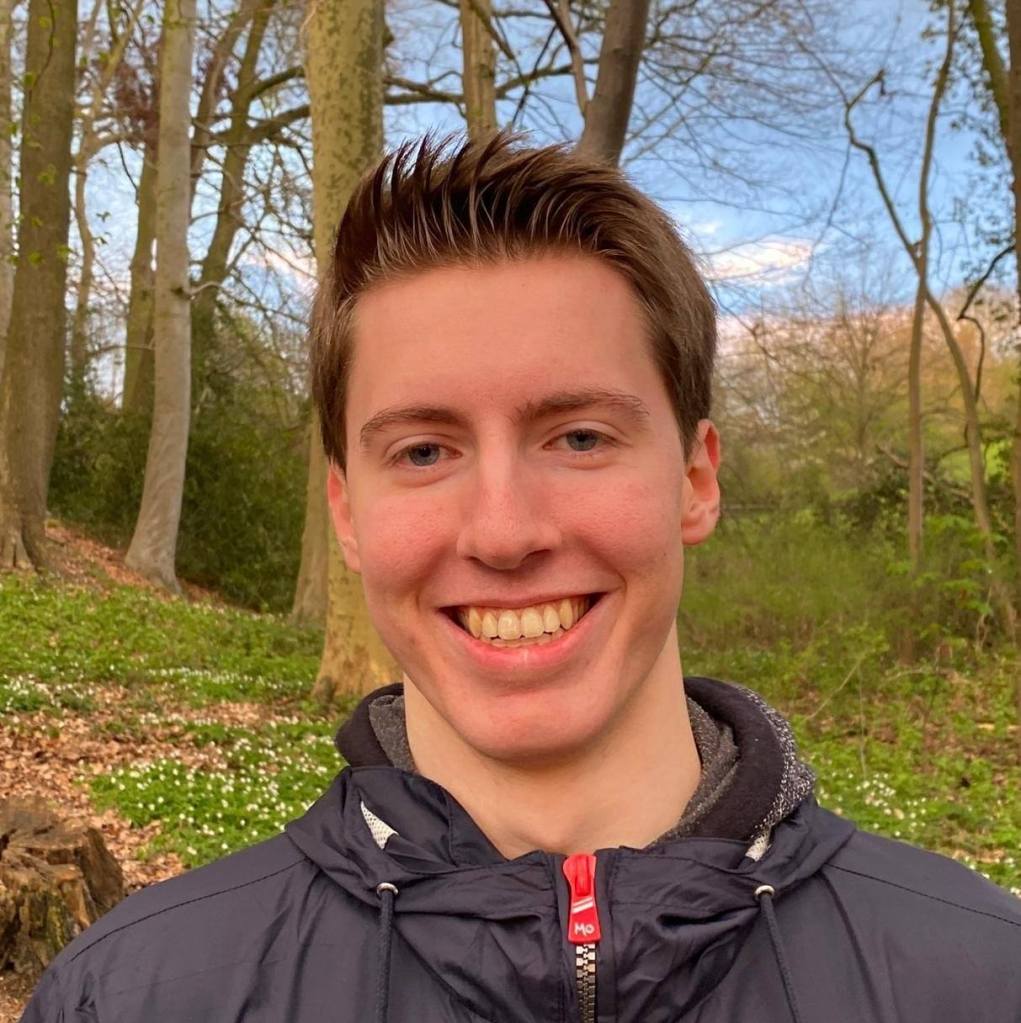
Congratulations to Arne Hendrickx!

Congratulations to Arne Hendrickx for obtaining

The MOE stipend

from the Ministry of Education in Taiwan. The goal of this grant and the related summer school in August at the National Sun Yat-Sen University in Kaohsiung is to learn Mandarin Chinese, get immersed in the Taiwanese culture, and get to know the academic landscape in Taiwan to facilitate and improve collaborations with Taiwanese universities.

Congratulations to Duván Cardona!

Congratulations to Duván Cardona for obtaining

The FWO Postdoctoral Fellowship

of The Research Foundation – Flanders (FWO).

About this fellowship: read more here!

The project: Fourier Integral Operators on Graded Lie groups.

About the project: the goal of this project is to contribute to the scientific program carried out for more than forty years (dating back to the works of Folland and Stein) in charge of extending the techniques from the Euclidean harmonic analysis to the more general setting of nilpotent Lie groups. The contribution of this project will be the construction of the theory of Fourier Integral operators (FIOs) on graded Lie groups. Developing a suitable theory of Fourier Integral Operators (FIOs) in this context will enable the solution of numerous unresolved problems in non-commutative harmonic analysis.

Keywords: Fourier Integral Operators, Microlocal Analysis, Control Theory, Harmonic Analysis, Partial Differential Equations.

Project Scope: the scope of this project involves the collaboration between the Ghent Analysis and PDE Center with a team formed by researchers from several foreign universities, including UCLA, University of Chicago, Cornell University, University of Wisconsin Madison, Queen Mary University of London, and the Imperial College London.

About Duván (visit his website here!). Duván Cardona earned his Bachelor’s degree in Mathematics from Universidad del Valle in 2015 under the supervision of Julio Delgado. He was associated as a Lecturer at different Colombian universities, such as Universidad de Los Andes and Pontificia Universidad Javeriana. In 2019, he began his doctoral studies under the supervision of Michael Ruzhansky. In 2018, he received an honorable mention from the Yu-Takeuchi Award, awarded by the Colombian Academy of Sciences. From 2022 to 2024, he will serve as the president of the scientific board for the continental project ICMAM Latin America. Adding to his achievements, he has been awarded this prestigious FWO Postdoctoral Fellowship by the FWO, Research Foundation, Flanders.

Read about Fourier Integral operators from Wikipedia here!.

Applications of Fourier Integral Operators in Real Life: Fourier integral operators serve as valuable tools for describing physical phenomena. They play a crucial role in understanding the evolution of waves over time as wave propagators. Waves, which are carriers of energy, can be observed in various domains, ranging from neuron pulses and blood flow in arteries to ocean waves. By employing Fourier integral operators, researchers can analyze and gain insights into diverse fields. For instance, in the medical field, these operators aid in the analysis of the cardiovascular system. In the realm of information theory, Fourier integral operators facilitate the study of waves like microwaves, radio waves, WiFi signals, and visible light. These operators are intrinsic mathematical objects that align with various numerical analysis techniques, enabling a comprehensive exploration of these phenomena and contributing to a deeper understanding of wave behavior and its implications in different areas of study.

Mini-course on Lie groupoids and pseudodifferential calculus

Dear all,

It is our pleasure to announce a mini-course “Lie groupoids and pseudodifferential calculus” given the next week by

Prof. Iakovos Androulidakis (National and Kapodistrian University of Athens, Greece)

Time:

Friday 23 September, 11:00-12:00 and 14:00-16:00 (CET)

Venue

Auditorium Leslokaal 3.1,Krijgslaan 281, Building S8, Ghent University (geography lecture room on 3rd floor) 

All are welcome to attend!

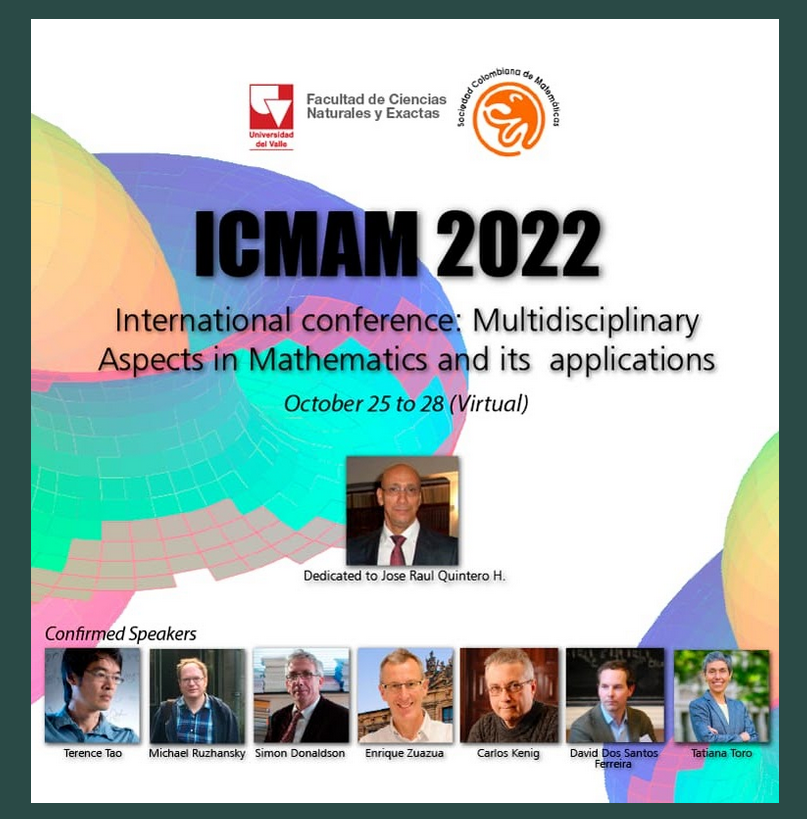
ICMAM 2022 Latin America

International conference:
Multidisciplinary Aspects in Mathematics and its applications (ICMAM) 2022, Latin America

The Department of Mathematics at the Universidad del Valle, Cali-Colombia, is delighted to invite you to the International conference: Multidisciplinary Aspects in Mathematics and its applications (ICMAM) 2022, Latin America. The honoree of this year at the conference is the Colombian Mathematician José Raúl Quintero, 2011 National Mathematics Award, Colombian Mathematical Society (Universidad del Valle, Cali-Colombia). The event will be a video conference and will take place via Zoom on the 25-28 October 2022.

The international conference: Multidisciplinary Aspects in Mathematics and its applications (ICMAM) seeks to contribute to the development of mathematical research in Latin America and the Caribbean, stimulate its visibility and promote exchange between mathematicians of the region and from other parts of the world. The ICMAM conferences will be taken every two years via online and you will find the information about the conference on this page.

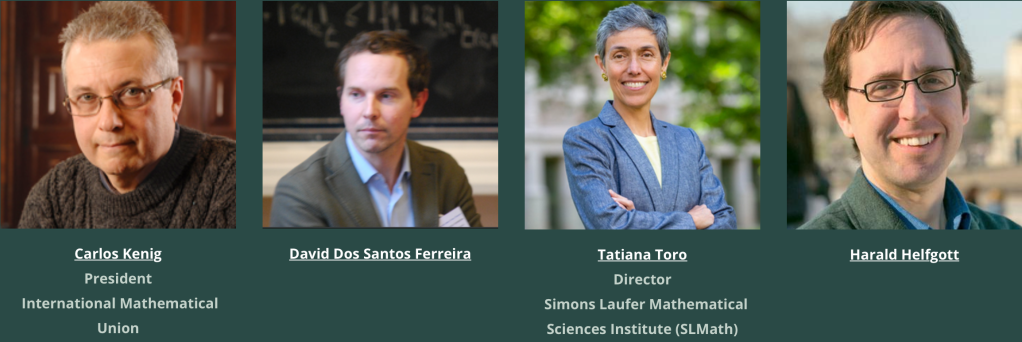
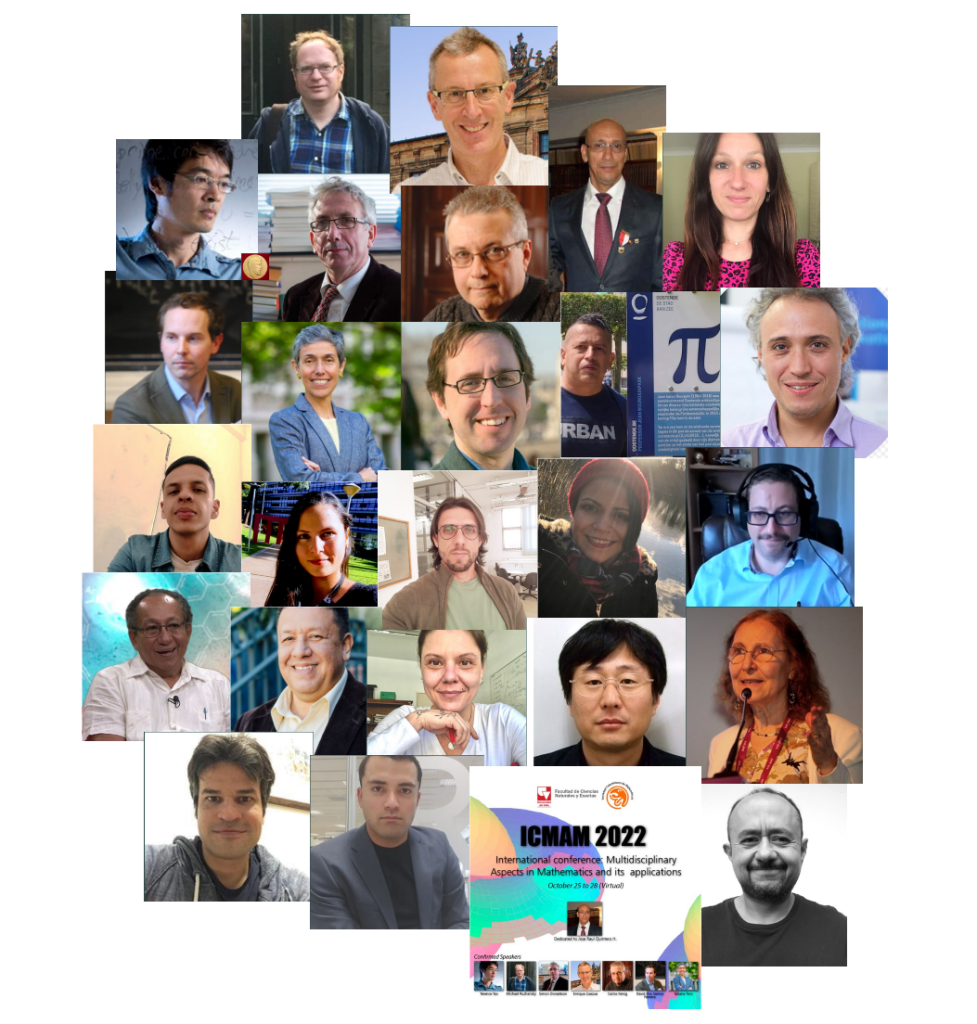
Plenary Speakers:

Confirmed Speakers:

  • Jose Raúl Quintero
    Universidad del Valle, Colombia
  • Tohru Ozawa
    Waseda University, Japan
  • Kristin E. Lauter
    Meta / Facebook
  • Manuel Del Pino
    University of Bath, UK
  • Andrés Villaveces
    Universidad Nacional de Colombia
  • Boris Zilber
    Oxford, UK
  • Thaís Jordão
    University of São Paulo, Brazil
  • Felipe Rincón
    Queen Mary University of London
  • Andreas Weiermann
    Ghent University
  • Paula Cerejeiras
    University of Aveiro, Portugal
  • Pavle Blagojević
    Mathematics institute – Freie Universität Berlin
  • Information of confirmed Speakers to be updated.


Organizing Committee:

  • Chair: Brian Grajales Triana, (Universidad de Pamplona, Colombia).
  • Co-chair: Karina Navarro Gonzalez (Universidad de São Paulo, Brazil).
  • Milton Manuel Aguirre (Universidad São Paulo, Brazil).
  • Jessica Gonzalez Hurtado (Freie Universität Berlin, Germany).
  • Julio Delgado (Universidad del Valle Cali, Colombia).
  • Marlio Paredes (Director of the Graduate Program in Mathematical Science at Universidad del Valle, Cali-Colombia).
  • Hector Jairo Martínez (Chair of the Department of Mathematics at Universidad del Valle, Cali-Colombia).

Scientific Board:

The honoree of this year at the conference is the Colombian Mathematician José Raúl Quintero, 2011 National Mathematics Award, Colombian Mathematical Society (Universidad del Valle, Cali-Colombia).

Webinar by AMS.org: Accessibility Best Practices for Moving Mathematics Online

Description: For many years there has been a push for moving teaching and research content online in a form that goes beyond just linking print versions of documents. The COVID pandemic has only accelerated this trend, forcing all faculty to focus on how to deliver courses online. However, hastily moving material online bears the risk that important accessibility considerations are neglected, threatening fair and inclusive education for all. This is especially true for mathematics and other STEM fields where complex structures such as equations and diagrams play an integral role. In this webinar we will advocate that in addition to moving content online quickly, instructors can use best practices developed for authors to ensure accessibility of math content from the start, thus avoiding additional and duplicate work.

Our presentation shall give an overview of different requirements on presentation and content for students and readers with special needs and how assistive technology support can be provided. We shall particularly concentrate on what this means for math content and how it is made accessible on the web. We argue that the web is the ideal platform for hosting and curating modern content regardless of their original sources like LaTeX, Word, or plain text. And we will demonstrate how accessibility can be practically a free byproduct of conversion from traditionally authored content. In conclusion we discuss ways of authoring, preparing, and teaching accessible web documents containing mathematics, highlighting some of the best practices.

Presented by Prof. Volker Sorge, University of Birmingham, UK & MathJax Consortium

Time:   July 13, 2020 02:00 PM in Eastern Time (US and Canada)

This information is presented here

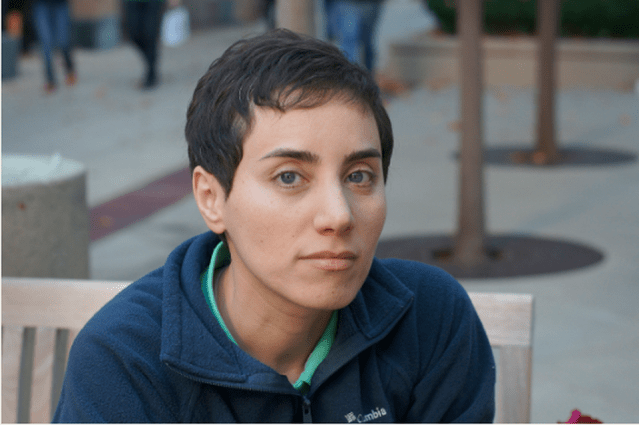
Secrets of the Surface: The Mathematical Vision of Maryam Mirzakhani

Filmed in Canada, Iran, and the United States, Secrets of the Surface: The Mathematical Vision of Maryam Mirzakhani examines the life and mathematical work of Maryam Mirzakhani, an Iranian immigrant to the United States who became a superstar in her field. In 2014, she was both the first woman and the first Iranian to be honored by mathematics’ highest prize, the Fields Medal. Read more

Trailer of the documentary here.

Also, Zala Films is supporting the May 12th initiative of the International Mathematical Union’s Committee for Women in Mathematics, which each year brings together virtual or local events celebrating women in mathematics. Due to COVID-19 (and by special agreement with Zala Films), individuals and organizations between April 1 and May 19, 2020, may access our film about the life and work of the Iranian mathematician Maryam Mirzakhani, Secrets of the Surface: The Mathematical Vision of Maryam Mirzakhani. (You can make a request for screening authorization here.

For more information, visit www.msri.org/general_events/24654.

We are sharing information from http://zalafilms.com/secrets/

Brief History of Mathematics

This ten part history of mathematics from Newton to the present day, reveals the personalities behind the calculations: the passions and rivalries of mathematicians struggling to get their ideas heard. Professor Marcus du Sautoy shows how these masters of abstraction find a role in the real world and proves that mathematics is the driving force behind modern science.

1 Newton and Leibniz

The story of two late 17th century mathematicians who worked on the same problem at the same time – the calculus – in which the great hero of British science, Newton, reveals himself to be a little less gentlemanly than his German rival, Leibniz. The calculus is one of the greatest achievements of mankind: an astronaut and an investment analyst pay homage to its enormous power. Listen here

2 Leonard Euler

how the mathematics that Leonard Euler invented two hundred years ago has transformed the internet. Euler’s solution to an 18th-century conundrum paved the way for the search engines most of us use every day. Listen here

3 Joseph Fourier

The mathematics of Joseph Fourier. It’s thanks to his mathematical insight that you can hear Marcus on the radio and that Brian Eno can create sounds that have never been heard before. Listen here

4 Evariste Galois

How the mathematics of the French revolutionary, Evariste Galois, has proved invaluable to particle physicists working today.The mathematics that Galois began, over two hundred years ago, now absolutely describes the fundamental particles that make up our universe. Listen here

5 Carl Friedrich Gauss

It was the German scientist and mathematician, Carl Friedrich Gauss, who said mathematics was the Queen of Science. One of his many mathematical breakthroughs, the Gaussian or normal distribution, is the lifeblood of statistics. It underpins modern medicine and is a valuable tool in the fight against prejudice. Listen here

6 The Mathematicians Who Helped Einstein

The pioneering nineteenth century mathematicians who helped Albert Einstien with his maths: Jonas Bolyai, Nicolas Lobachevski and Bernhard Riemann. Without the mathematics to describe curved space and multiple dimensions, the theory of relativity doesn’t really work. Listen here

7 Georg Cantor

Georg Cantor, the mathematician who showed us how to carry on counting when the numbers run out. An insight into the nature of infinity that Roger Penrose believes helps to explain why the human brain will always be cleverer than artificial intelligence. Listen here

8 Henri Poincare

Henri Poincare, the man who proved there are certain problems that mathematics will never be able to answer: a mathematical insight that gave rise to chaos theory. Listen here

9 Hardy and Ramanujan

G.H.Hardy, the mathematician who insisted he had never done anything useful. And yet his work on the “diabolical malice” inherent in prime numbers inspired the millions of codes that now help to keep the internet safe. Listen here

10 Nicolas Bourbaki

The mathematician that never was, Nicolas Bourbaki. A group of French mathematicians, working between the two world wars and writing under the pseudonym Nicolas Bourbaki transformed their discipline and paved the way for several mathematical breakthroughs in the 21st century. Listen here

Info from BBC Radio 4