
On 13 October 2026, our mirror laboratory in mathematics and artificial intelligence was presented to King Philippe, Queen Mathilde and President Kassym-Jomart Tokayev during their visit to Alem.ai in Astana. Ghent University Rector Petra De Sutter also participated in the visit, bringing the initiative into the programme of the Belgian state visit to Kazakhstan.
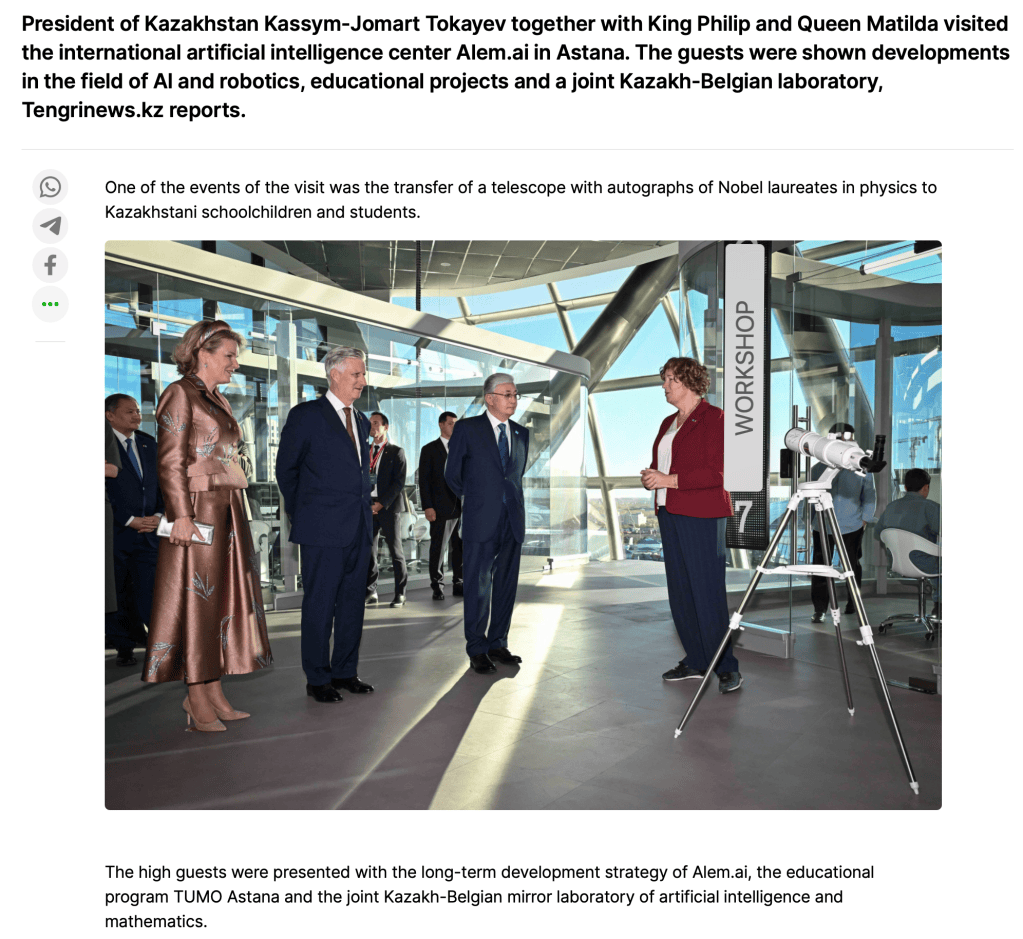
Queen Mathilde, King Philippe, President Tokayev and Rector Petra De Sutter at Alem.ai. Photo credit Akorda, reproduced in Tengrinews. Read the report
Developing our mirror laboratory
Michael Ruzhansky proposed the initiative to Rector Petra De Sutter during the rectorial mission to Kazakhstan and Uzbekistan in November 2025. With her strong support, our Ghent Analysis & PDE Center worked with the rectorate, Anna Sashchenko of UGent’s Eureast Platform, the Institute of Mathematics and Mathematical Modeling in Almaty, and Alem.ai in Astana to develop the partnership.
A Memorandum of Understanding was signed in Brussels on 22 June 2026 by the UGent Rector and Kazakhstan’s ministers responsible for science and for AI and digital development. See our earlier announcement.
Discussing the Ghent–Alem.ai agreement, Kazakhstan’s Minister of Science and Higher Education, Sayasat Nurbek, stated: “Belgian specialists are especially strong in algorithms and mathematical modeling.” (Qazinform, 12 October 2026)
Our mirror laboratory in coverage of the royal visit
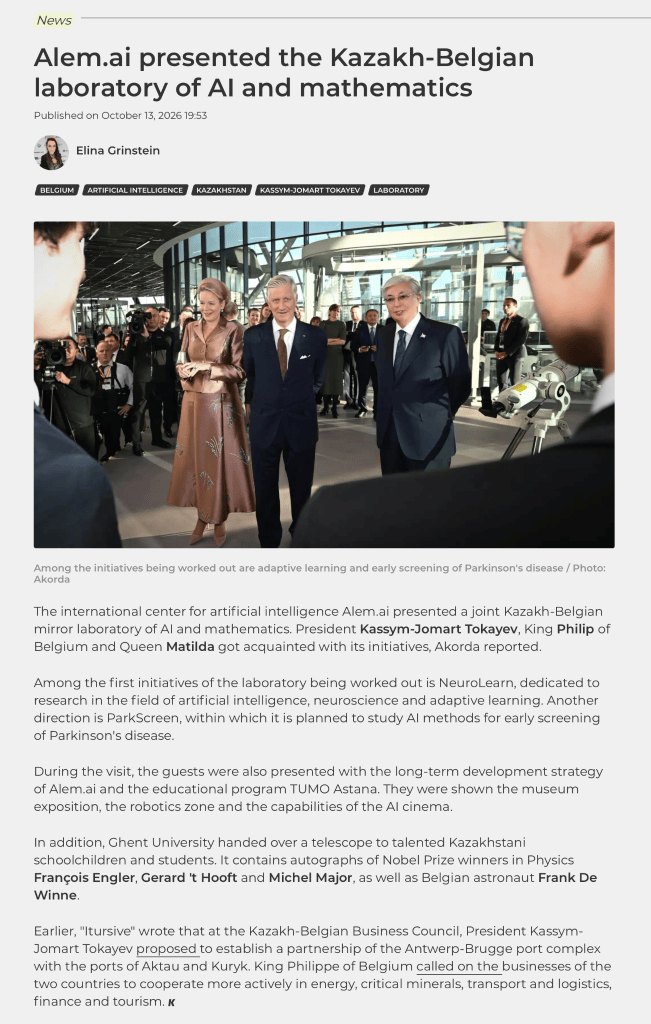
Kursiv’s report on the laboratory’s presentation during the royal visit, published 13 October 2026. Photograph credited to Akorda. Read the original article
Mathematics and AI developed at Ghent
The Kazakhstan laboratory is our second international laboratory in mathematics, following the existing since 2023 remote laboratory in Armenia. It is conceived as a remote extension of the Ghent Analysis & PDE Center, funded externally (our remote laboratory grants in Armenia are about 1,000,000 USD), with a research programme under our scientific direction from our center. Its remit covers mathematical analysis and partial differential equations, artificial intelligence, modelling and engineering computation, connecting fundamental research with applications.
The Parkinson’s screening direction highlighted in the news coverage builds on research developed in our group at Ghent. Xuechao Wang carried out his doctoral research here under Michael Ruzhansky’s supervision, supported first by his FWO Odysseus grant and then by Methusalem. Professor Sven Nõmm of Tallinn University of Technology (TalTech), Estonia, was external co-supervisor. Junqing Huang contributed to all five published Parkinson’s papers and shared first authorship of the LSTM-CNN study.
This work develops efficient neural networks for analysing dynamic handwriting signals and explainable AI methods that identify which parts of a handwriting trajectory influence a prediction. It provides a research foundation for further work on Parkinson’s screening, with broader clinical validation needed before medical use. The laboratory’s programme extends beyond Parkinson’s disease to wider questions in mathematics and AI.
Our biomedical imaging research also includes a 2020 study of cervical cancer patients. Working with oncology researchers, Michael Ruzhansky and Junqing Huang contributed mathematical image processing to microscopy images of red blood cells from patients undergoing radiotherapy. The methods helped clarify nanoparticle boundaries for measurement.
Within UGent, our collaboration with Professor Andre Skirtach and Dr Bogdan Parakhonskiy at the Laboratory for NanoBioTechnology includes particle-image segmentation from very small datasets. This published joint work connects mathematical and AI methods with experimental microscopy.
Selected research and doctoral work
Xuechao Wang, Junqing Huang, Marianna Chatzakou, Kadri Medijainen, Pille Taba, Aaro Toomela, Sven Nõmm and Michael Ruzhansky. A Light-weight CNN Model for Efficient Parkinson’s Disease Diagnostics. IEEE CBMS (2023), 616–621.
Xuechao Wang, Junqing Huang, Marianna Chatzakou, Sven Nõmm, Elli Valla, Kadri Medijainen, Pille Taba, Aaro Toomela and Michael Ruzhansky. Comparison of one- two- and three-dimensional CNN models for drawing-test-based diagnostics of the Parkinson’s disease. Biomedical Signal Processing and Control 87 (2024), 105436.
Xuechao Wang, Junqing Huang, Marianna Chatzakou, Kadri Medijainen, Aaro Toomela, Sven Nõmm and Michael Ruzhansky. LSTM-CNN: An efficient diagnostic network for Parkinson’s disease utilizing dynamic handwriting analysis. Computer Methods and Programs in Biomedicine 247 (2024), 108066.
Xuechao Wang, Sven Nõmm, Junqing Huang, Marianna Chatzakou and Michael Ruzhansky. An Efficient Neural Network for the Diagnosis of Parkinson’s Disease Using Dynamic Handwriting Analysis. Extended Abstracts MWCAPDE 2023, Birkhäuser (2024), 97–104.
Xuechao Wang, Sven Nõmm, Junqing Huang, Kadri Medijainen, Aaro Toomela and Michael Ruzhansky. PointExplainer: Towards transparent Parkinson’s disease diagnosis. Information Fusion 129 (2026), 104064.
Sargylana Mamaeva, Irina Kononova, Michael Ruzhansky, Petr Nikiforov, Nadezhda Nikolaeva, Alexandr Pavlov, Nyurguyna Fedorova, Junqing Huang, Motrena Semenova, Daiaana Barashkova, Lyubov Frolova and Georgy Maksimov. Using Scanning Electron Microscopy and Atomic Force Microscopy to Study the Formation of Nanoparticles on Red Blood Cell Surface in Cervical Cancer Patients. International Journal of Biomedicine 10(1) (2020), 70–75.
Marianna Chatzakou, Junqing Huang, Bogdan Parakhonskiy, Michael Ruzhansky, Andre Skirtach, Junnan Song and Xuechao Wang. Performing Particle Image Segmentation on an Extremely Small Dataset. Extended Abstracts 2021/2022: Ghent Analysis and PDE Seminar, Birkhäuser (2024), 295–304.
Xuechao Wang. Deep Learning for Dynamic Handwriting Analysis: Multi-Dimensional, Efficient, and Explainable Diagnosis of Parkinson’s Disease. Ghent University doctoral thesis, defended 23 January 2026.
Sources
- В Alem.ai представили казахстанско-бельгийскую лабораторию ИИ и математики. Kursiv Media, 13 October 2026. Reports the laboratory’s presentation and the NeuroLearn and ParkScreen directions.
- Kazakhstan and Belgium to sign 12 higher education deals. Qazinform, 12 October 2026. Includes Minister Sayasat Nurbek’s comments on the Ghent–Alem.ai agreement and Belgian expertise.
- Телескоп с автографами нобелевских лауреатов передали казахстанским школьникам. Tengrinews, 13 October 2026. Covers the Alem.ai visit, the laboratory and UGent’s telescope presentation; includes photographs credited to Akorda.
- Kazakhstan and Belgium’s foreign ministries sign three-year cooperation roadmap. Kursiv Media, 13 October 2026. Places the state visit in the wider context of bilateral diplomatic cooperation.
- Belgium and Kazakhstan: a strengthened partnership to tackle the challenges of today and tomorrow. Belgian FPS Foreign Affairs, 9 October 2026. Official background on the state visit and its academic and economic programme.
- A Landmark Partnership in the Mathematical Sciences. Ghent Analysis & PDE Center, 23 June 2026. Our original announcement of the 22 June memorandum and the mirror laboratory.
- Laboratory for NanoBioTechnology. Ghent University, Department of Biotechnology. Background on our collaborating laboratory and its microscopy and biomedical research.

